Research Article | | Peer-Reviewed

Influence of Jovian Planetary Motion on Sunspot Cycles

Received: 13 February 2026     Accepted: 28 February 2026     Published: 12 March 2026
Views:       Downloads:
Abstract

Sunspots are observable phenomena that emerge on the Sun’s surface, typically appearing in groups during intervals when the toroidal magnetic field of the Sun is heightened. These occurrences are not solely determined by the magnetic field’s strength; there is also a stochastic, or noise-related, component that influences sunspot manifestation during these elevated periods. This paper demonstrates that the periods of increased toroidal magnetic field are driven by the collective movement of the Jovian planets, which alters the location of the solar system’s center of mass relative to the Sun’s center. This dynamic motion introduces a cycle that is very close to 11 years in length. When both polarities of the Sun’s magnetic field are considered, this results in an overall 22-year magnetic cycle. For these effects to be effective the Sun’s dynamo must extend into the near surface layers. Sunspots emerge over both the northern and southern hemispheres of the Sun, following the typical butterfly pattern that is characteristic of sunspot distribution. While the collective motion of the Jovian planets drives the cyclical maxima in the Sun’s toroidal magnetic field, it is identified as a necessary-but not solely sufficient-factor for the development of sunspots. Based on the influence of the Jovian planets, it is predicted that the maximum for solar cycle 25 will occur between November and December 2024. Furthermore, solar cycle 26 is expected to reach its maximum around January 2037.

Published in American Journal of Modern Physics (Volume 15, Issue 2)
DOI 10.11648/j.ajmp.20261502.12
Page(s) 24-29
Creative Commons

This is an Open Access article, distributed under the terms of the Creative Commons Attribution 4.0 International License (http://creativecommons.org/licenses/by/4.0/), which permits unrestricted use, distribution and reproduction in any medium or format, provided the original work is properly cited.

Copyright

Copyright © The Author(s), 2026. Published by Science Publishing Group

Keywords

Sunspots, Sunspot Cycles, Sun Magnetic Fields

1. Introduction
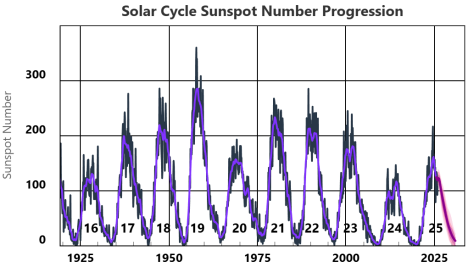
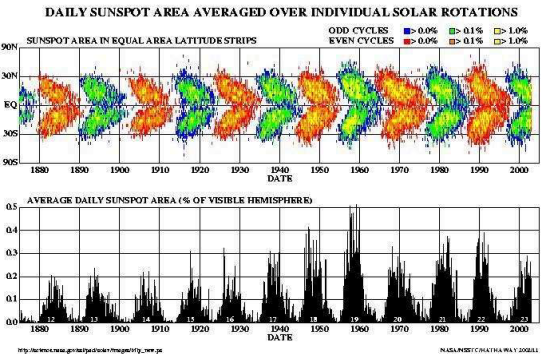
The number of sunspots occurring on the surface of the Sun has been accurately counted ever since about the year 1750. To date 25 groups have been observed with peak counts of about 100 to 250 sunspots per month with nearly zero sunspots occurring between such groups. The sunspots observed for cycles 16 to 25 is shown in Figure 1. This figure snows the sunspots counted over the Sun’s visible surface from about 1925 to 2025. Figure 2 shows sunspots counted over the tine period from 1880 to 2000 with the occurrence of sunspots broken down by solar latitude of occurrence in the upper trace and by total number lumped together as shown in the lower trace. Differential rotation of the Sun causes the Sun to exhibit a toroidal magnetic field about the Sun’s rotation axis. Sunspots occur when the Sun’s toroidal magnetic field breaks and then reenters the solar surface. The members of a pair are seldom clearly discernible.
Sunspots normally start at a solar latitude of about ±30 with opposite magnetic polarities leading in the different solar hemispheres of northern and southern. Sunspot pairs then migrate toward the solar equator where they disappear. In a subsequent cycle the opposite magnetic polarity then leads in the respective hemisphere so that the total magnetic cycle time is approximately 22 years, This is represented in the upper trace by the alternating colors. This is usually called a butterfly diagram of solar sunspot activity.
The number of sunspots observed in the northern and southern hemispheres is approximately equal but asymmetric and seemingly uncorrelated from solar cycle to solar cycle. It is generally believed that the number of sunspots is correlated to the toroidal magnetic field of the Sun. The peaking in the number of sunspots is said to be in phase to the peaking of the Sun’s toroidal magnetic field. In a previous paper it was shown that maxima in the number of sunspots correlate to collective motions of the Jovian planets. In this paper we want to show that the number of sunspots correlates to maximas in the Sun’s toroidal magnetic field and then also to the collective motion of the Jovian planets. This means that the Sun’s dynamo must be shallow rather than deep as has been normally assumed. Several recent papers have taken the Sun’s dynamo as being dominated by surface related factors. .
2. Results and Discussion
Figure 1. Sunspots are shown for the time period from 1925 fo 2025 as compiled by the Space Weather Center .
As previously shown, the collective motion of the Jovian planets can be correlated with the occurrence of sunspots. For each planet if X equals the distance from the center of the Sun to the center of mass and D equals the distance from the center of the Sun to the center of a planet then
MSX= MP (D- X)thenX=MPMS+ MP D(1)
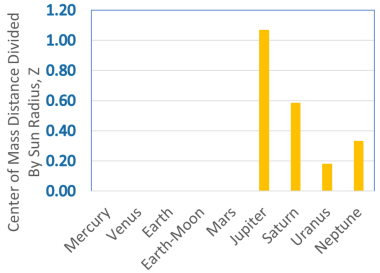
Dividing X by the radius of the Sun, RS, then yields a useful variable Z = X/R S. If Z > 1 then the center of mass of the Sun planet system actually lies outside the surface of the Sun. For the Jovian planets: Z Jupiter = 1.07, Z Saturn = 0.586, Z Uranus = 0.180, and Z Neptune = 0.332. Figure 2 shows the ratio of the distance from the center of the Sun compared to the Sun radius for the individual planets. The Z values for the terrestrial planets are at least about three orders of magnitude smaller. It is then a very good approximation that the terrestrial planets revolve about the center of the Sun. But the Jovian planets and Sun must be treated as a system that moves about the collective center of mass. The orbital period for the Jovian planets are: P Jupiter = 11.86 years, P Saturn = 29.42 years, P Uranus = 83.75 years, and P Neptune = 163.7 sidereal years. Using circular orbits angular speeds can then be determined by dividing 360 degrees by the orbital period. These are then 30.35 degrees per year for Jupiter, 12.24 degrees per year for Saturn, 4.299 degrees per year for Uranus, and 2.199 degrees per year for Neptune. Neptune has thus completed less than 2 orbits for the time period over which the number of sunspots has accurately been counted.
The Z values can then be projected onto a particular axis direction for the different dates. The use of Mathematica allows details of the orbit and distances to be determined, but it is mainly the orbital angular positions that are of interest and “The Planets Tday.com” app gives the angular orbital positions and only that information.
Figure 2. The upper panel shows the butterfly pattern of observed sunspots for the time period 1880 to 2000. The lower panel shows sunspots counted over the visible Sun for the time period 1880 to 2000.
In Figure 3 the positions of the solar system planets are shown for a particular date such that the observer is at a distant point at 270°. Zero degrees is straight up and angles increase in the counterclockwise direction. The figure results from “The Planets Today.com” app. Contributions from the planets Saturn, Uranus and Neptune can be similarly added. The projected Z values are then given by
Z=1.07*CosθJ +0.586*CosθS+ 0.180*Cos(θU)+ 0.332*Cos(θN)(2)
Where the coefficients are as determined by Equation (1) and subscripts refer to the planets Jupiter, Saturn, Uranus, and Neptune. This equation determines the projected Z values as the different planets rotate. In a previous paper Z had been defined with a minus 1 multiplier which has not been included here. If we assume we are observing a distant star with planets from a point within the plane of the planets, then Z is just the distance from the star to the center of mass of that system. It will be observed that the maximum number of sunspots appearing on the star will occur at a local extrema of Z.
In Figure 4 the Z values as a function of time is plotted. The plot range spans the time corresponding to Solar Cycles 14 to a projected Cycle 26. The positions corresponding to the peak sunspot numbers have been indicated by the solar cycle numbers. Figure 5 shows an enlargement of this figure for Solar Cycles 22 to 25. Thus, the peak activity for Cycle 25 appeared in the year 2024.9 equivalent to about November-December 2024. The position of the maxima associated with cycle 25 has been recalculated and is believed accurate to 0.3 years. This corresponds precisely to the time for which the peak in solar cycle 25 has been observed. This is illustrated in Figure 5. The peak Z values labeled for the other labeled extrema correspond to the peaks for the respective solar cycles. It is then predicted that Solar Cycle 26 will occur in year 2035 or about January of 2035. It is asserted that a maximum in the number of sunspots corresponds to a maximum in the Sun’s toroidal magnetic field and thus also to a local extrema of Z(t). The total magnetic cycle then corresponds to approximately 22 years. The Sun’s poloidal magnetic field peaks 90° out of phase so that the magnetic energy switches from the toroidal to poloidal to opposite polarity toroidal io opposite polarity poloidal before completing a cycle in approximately 22 years. The peaking of the toroidal field and the occurrence of sunspots are in phase [c].
To fit the predicted Z values for the different sunspot cycles requires that the toroidal magnetic field be very near the Sun’s surface. In this description the position of the Jovian planets becomes a necessary, but not a sufficient condition for the appearance of sunspots. A large noise or stochastic variation of the number of sunspots is then expected due to variations in surface granulation. Similarly, this noise, being random, would introduce an asymmetry in the number of sunspots between the northern and southern hemispheres of the Sun. The positions of the Jovian planets then accounts for the grouping of sunspots but is not causal for the appearance of any individual sunspots. Assuming again nearly circular orbits the repeat time for any particular pattern of the Jovian planets requires a common multiplier of the periods equal to 4.78E6 years. The number of sunspots introduced by this surface sunspot activity is substantial and can shift the overall peak by 1 to 3 years. For this effect to be effective it requires that the solar dynamo be shallow. Based on the influence of the Jovian planets, it is predicted that the maximum for solar cycle 25 will occur between November and December 2024. Furthermore, solar cycle 26 is expected to reach its maximum around January 2037.
Figure 3. The distance from the Sun center to the center of mass compared to Sun's radius, the Z value, is shown for the planets in the solar system. Since the mass of the Sun is approximately 330,000 times the mass of the Earth, the Z values for the terrestrial planets are very small.
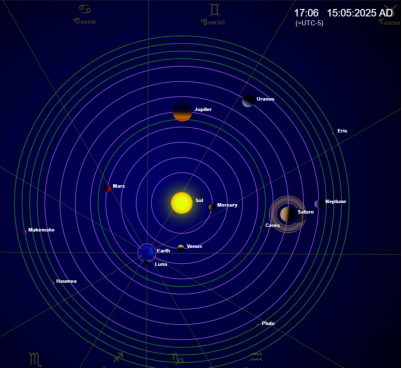
Figure 4. The relative angles to the planets in the solar system are shown as determined by the app The-Planets-Today.com. The angles have been determined by the angle measured counterclockwise from the vertical line.
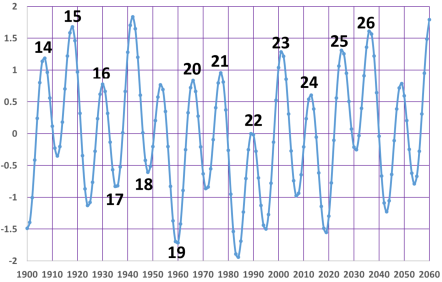
Figure 5. Projected Z values are plotted for the time period 1900 to 2060.
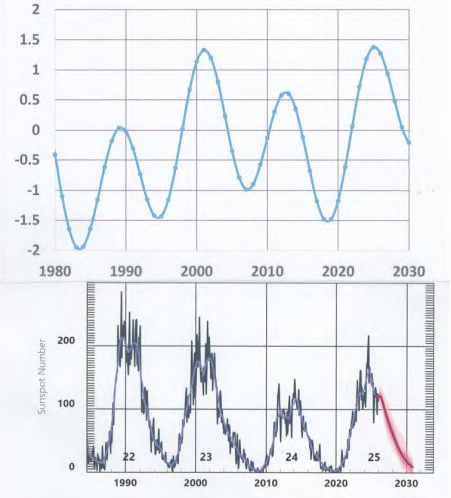
Figure 6. The upper panel shows an expanded view of projected Z values for the time period 1990 to 2030 corresponding to solar cycles 22 to 25. The lower panel shows the Space Weather Sunspot Count for Cycles 22 to 25.

3. Conclusions
The collective motion of the Jovian planets implies that the Sun’s toroidal magnetic field will reach peak values and that sunspots will appear in groups separated by very close to 11 years as shown in Figures 5 and 6. The variation of the Sun’s toroidal magnetic field can then smoothly follow the collective motion of the Jovian planets. But the actual number of sunspots observed can vary appreciably because of the large surface noise factor, or stochastic factor. This is the first time that the Sun’s toroidal magnetic field variations have been attributed to the collective motion of the Jovian planets. The relative positions of the Jovian planets is then a necessary, but not a sufficient condition, for the appearance of any individual sunspot.
Author Contributions
Fred John Cadieu: Conceptualization, Resources, Formal Analysis, Writing – review & editing
Conflicts of Interest
The author declares no conflicts of interest.
References
[1] Space Weather Prediction Center, NOAA,
[2] David Hathaway, NASA Marshall Space Flight Center, Solar Physics
[3] Allison L. Liu and Philip H. Scherrer (2022) The Astrophysical Journal Letters, 927: L2 (5 pp), 2022 March 1
[4] Babcock, H. W. (March 1961). "The Topology of the Sun's Magnetic Field and the 22-YEAR Cycle". The Astrophysical Journal. 133: 572–587.
[5] Leighton, Robert B. (April 1969). "A Magneto-Kinematic Model of the Solar Cycle". The Astrophysical Journal. 156: 1.
[6] Charbonneau, P. (2014). "Solar Dynamo Theory". Annual Review of Astronomy and Astrophysics. 52: 251–290.
[7] Cadieu, F. J. (2024), Jovian Planet Influence on the Forcing of Sunspot Cycles. World Journal of Condensed Matter Physics, 14, 1-9.
[8] Mandal, Krishnendu and Kosovichev, Alexander G. [2026], Helioseismic evidence that the solar dynamo originates near the tachocline,
[9] Vasil, G. M. et al. The solar dynamo begins near the surface. Nature629, 769–772.
[10] Choudhuri, A. R. On the possibility of an alpha 2 omega -type dynamo in a thin layer inside the Sun. ApJ355, 733.
[11] Dikpati, M., Gilman, P. A., Cally, P. S. & Miesch, M. S. Axisymmetric MHD instabilities in solar/stellar tachoclines. ApJ692, 1421–1431.
[12] NASA Planetary Physical Parameters,
Cite This Article
  • APA Style

    Cadieu, F. J. (2026). Influence of Jovian Planetary Motion on Sunspot Cycles. American Journal of Modern Physics, 15(2), 24-29. https://doi.org/10.11648/j.ajmp.20261502.12

    Copy | Download

    ACS Style

    Cadieu, F. J. Influence of Jovian Planetary Motion on Sunspot Cycles. Am. J. Mod. Phys. 2026, 15(2), 24-29. doi: 10.11648/j.ajmp.20261502.12

    Copy | Download

    AMA Style

    Cadieu FJ. Influence of Jovian Planetary Motion on Sunspot Cycles. Am J Mod Phys. 2026;15(2):24-29. doi: 10.11648/j.ajmp.20261502.12

    Copy | Download

  • @article{10.11648/j.ajmp.20261502.12,
      author = {Fred John Cadieu},
      title = {Influence of Jovian Planetary Motion on Sunspot Cycles},
      journal = {American Journal of Modern Physics},
      volume = {15},
      number = {2},
      pages = {24-29},
      doi = {10.11648/j.ajmp.20261502.12},
      url = {https://doi.org/10.11648/j.ajmp.20261502.12},
      eprint = {https://article.sciencepublishinggroup.com/pdf/10.11648.j.ajmp.20261502.12},
      abstract = {Sunspots are observable phenomena that emerge on the Sun’s surface, typically appearing in groups during intervals when the toroidal magnetic field of the Sun is heightened. These occurrences are not solely determined by the magnetic field’s strength; there is also a stochastic, or noise-related, component that influences sunspot manifestation during these elevated periods. This paper demonstrates that the periods of increased toroidal magnetic field are driven by the collective movement of the Jovian planets, which alters the location of the solar system’s center of mass relative to the Sun’s center. This dynamic motion introduces a cycle that is very close to 11 years in length. When both polarities of the Sun’s magnetic field are considered, this results in an overall 22-year magnetic cycle. For these effects to be effective the Sun’s dynamo must extend into the near surface layers. Sunspots emerge over both the northern and southern hemispheres of the Sun, following the typical butterfly pattern that is characteristic of sunspot distribution. While the collective motion of the Jovian planets drives the cyclical maxima in the Sun’s toroidal magnetic field, it is identified as a necessary-but not solely sufficient-factor for the development of sunspots. Based on the influence of the Jovian planets, it is predicted that the maximum for solar cycle 25 will occur between November and December 2024. Furthermore, solar cycle 26 is expected to reach its maximum around January 2037.},
     year = {2026}
    }
    

    Copy | Download

  • TY  - JOUR
    T1  - Influence of Jovian Planetary Motion on Sunspot Cycles
    AU  - Fred John Cadieu
    Y1  - 2026/03/12
    PY  - 2026
    N1  - https://doi.org/10.11648/j.ajmp.20261502.12
    DO  - 10.11648/j.ajmp.20261502.12
    T2  - American Journal of Modern Physics
    JF  - American Journal of Modern Physics
    JO  - American Journal of Modern Physics
    SP  - 24
    EP  - 29
    PB  - Science Publishing Group
    SN  - 2326-8891
    UR  - https://doi.org/10.11648/j.ajmp.20261502.12
    AB  - Sunspots are observable phenomena that emerge on the Sun’s surface, typically appearing in groups during intervals when the toroidal magnetic field of the Sun is heightened. These occurrences are not solely determined by the magnetic field’s strength; there is also a stochastic, or noise-related, component that influences sunspot manifestation during these elevated periods. This paper demonstrates that the periods of increased toroidal magnetic field are driven by the collective movement of the Jovian planets, which alters the location of the solar system’s center of mass relative to the Sun’s center. This dynamic motion introduces a cycle that is very close to 11 years in length. When both polarities of the Sun’s magnetic field are considered, this results in an overall 22-year magnetic cycle. For these effects to be effective the Sun’s dynamo must extend into the near surface layers. Sunspots emerge over both the northern and southern hemispheres of the Sun, following the typical butterfly pattern that is characteristic of sunspot distribution. While the collective motion of the Jovian planets drives the cyclical maxima in the Sun’s toroidal magnetic field, it is identified as a necessary-but not solely sufficient-factor for the development of sunspots. Based on the influence of the Jovian planets, it is predicted that the maximum for solar cycle 25 will occur between November and December 2024. Furthermore, solar cycle 26 is expected to reach its maximum around January 2037.
    VL  - 15
    IS  - 2
    ER  - 

    Copy | Download

Author Information